
A parcel can weigh 3 kg on a scale and still be billed at 6 kg for air shipping. The difference is volumetric weight: a way to account for the space a carton occupies. It is especially important for shoes, jackets, bedding and other goods that are light for their size.
Tavren air shipping is ₹2,000 per chargeable kg. For each carton, we compare actual packed weight with volumetric weight and use whichever is higher. Here is how to check that number before you buy or pack.
Measure the packed carton
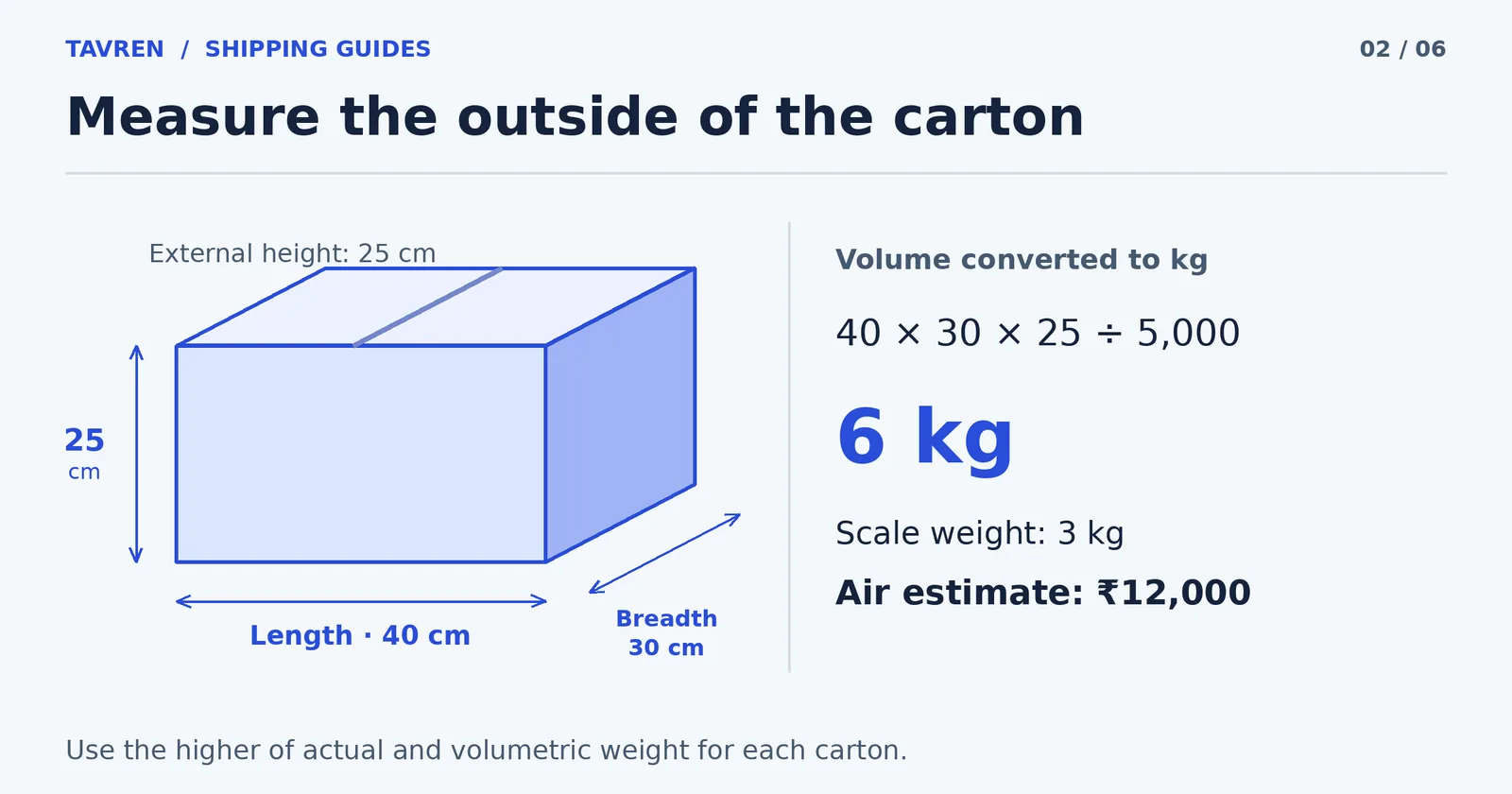
Measure the external length, breadth and height in centimetres after the carton is packed and closed. Include packaging that extends beyond the main box. Then weigh the complete carton, including the goods and protective materials.
Ask the seller for the dimensions of the packed carton. A seller may put a shoebox inside a larger outer carton, or ship several items in one package. Ask for the final package measurements rather than relying on a product specification sheet.
Use the Tavren volumetric formula
Volumetric weight in kg = length × breadth × height in cm ÷ 5,000.
For a 40 × 30 × 25 cm carton, the calculation is 40 × 30 × 25 ÷ 5,000 = 6 kg. If the actual packed weight is 3 kg, use 6 kg. At ₹2,000 per chargeable kg, the air shipping estimate is ₹12,000. If that same carton weighs 10 kg, use 10 kg and the estimate becomes ₹20,000.
The divisor of 5,000 is the one Tavren uses. Other services may apply different divisors or billing rules, so compare the full calculation when comparing quotations.
Calculate different cartons separately
Do not combine all the actual weights and all the volumetric weights before choosing the higher total. Compare the two weights for each carton first, then add the chargeable weights.
| Carton | Actual weight | Volumetric weight | Chargeable weight |
|---|---|---|---|
| A40 × 30 × 25 cm | 3 kg | 6 kg | 6 kg |
| B40 × 30 × 25 cm | 10 kg | 6 kg | 10 kg |
| Total | 13 kg | 12 kg | 16 kg |
In this example, the air charge is 16 × ₹2,000 = ₹32,000. Comparing only the combined actual weight of 13 kg with the combined volumetric weight of 12 kg would understate the result. The carton-by-carton calculation matters whenever your packages have different densities.
Reduce unnecessary space safely
Ask the seller whether a smaller outer carton will protect the goods adequately. A 3 kg shipment in a 30 × 25 × 20 cm carton has a volumetric weight of 3 kg, giving an air estimate of ₹6,000. That is ₹6,000 less than the 40 × 30 × 25 cm example, provided the smaller packaging is suitable.
Keep the protection needed for fragile items. Saving volume is not helpful if the goods arrive damaged. Retail packaging may also matter for gifts, collectibles, warranties or resale, so decide what must stay before asking a seller to change it. Do not assume Tavren will open or repack incoming parcels as part of standard forwarding.
Compare sea using cubic metres
Sea freight uses volume directly. The 40 × 30 × 25 cm carton occupies 0.03 m³: divide the same dimensions by 1,000,000 instead of 5,000. Tavren sea shipping is ₹27,600 per m³ with a 1 m³ minimum, so sending this one carton by sea would cost ₹27,600 at the minimum.
That is why reducing air volumetric weight and choosing sea are different decisions. Our air versus sea comparison shows when each mode makes sense.
Estimate first and pay after measurement in India
Enter identical cartons in the shipping estimator. For mixed sizes, send a carton list on WhatsApp so we can review the shipment together. Every item needs approval before dispatch to the receiving warehouse.
Your final shipping charge follows the weight and measurements at our Indian warehouse. We confirm the amount and collect payment before delivery. If a seller cannot provide reliable package measurements, treat the initial estimate as provisional rather than a fixed bill.