
A graphics card can cost less abroad, or the exact model you want may not be on sale in India at all. Buying one from the USA or China is straightforward, but a card is expensive and fragile. A few checks before you pay are the difference between a good deal and an expensive problem.
With Tavren, a card travels by air at ₹2,000 per chargeable kg, usually 12–14 days from our overseas warehouse. Customs duty, clearance and delivery to your door are included.
Check these before you buy
Warranty. Ask how the manufacturer handles claims for a card bought in another country. Some brands tie warranty to the region of purchase, so a claim can mean sending the card back to that country. Factor that in when you weigh up the saving.
Fit and power. Check the card’s length, slot width and power connectors against your case and power supply. Large cards often need a 16-pin connector, or more wattage than you have now.
Returns. A store’s return window usually counts from delivery to our overseas warehouse, not to India. Sending a card back from India is rarely practical, so buy a model you are sure of.
Used cards. Second-hand cards are common on marketplaces in both countries. Ask the seller for photos and a recent benchmark or stress-test result. You can also add our paid inspection, which photographs the card at the warehouse before it flies.
Where to buy
From the USA: buy from any retailer that delivers within the United States and have it delivered to our receiving address. Our Delaware address has no state sales tax, a noticeable saving on an expensive card.
From China: Taobao, JD.com and 1688 list a wide range of new and used cards. Our China rate starts at our Shenzhen or Hong Kong warehouse. The seller’s delivery to that warehouse is separate, and usually small. If you can’t pay a Chinese seller yourself, we can buy for you: the price is confirmed in rupees and paid in advance.
What shipping costs for a card
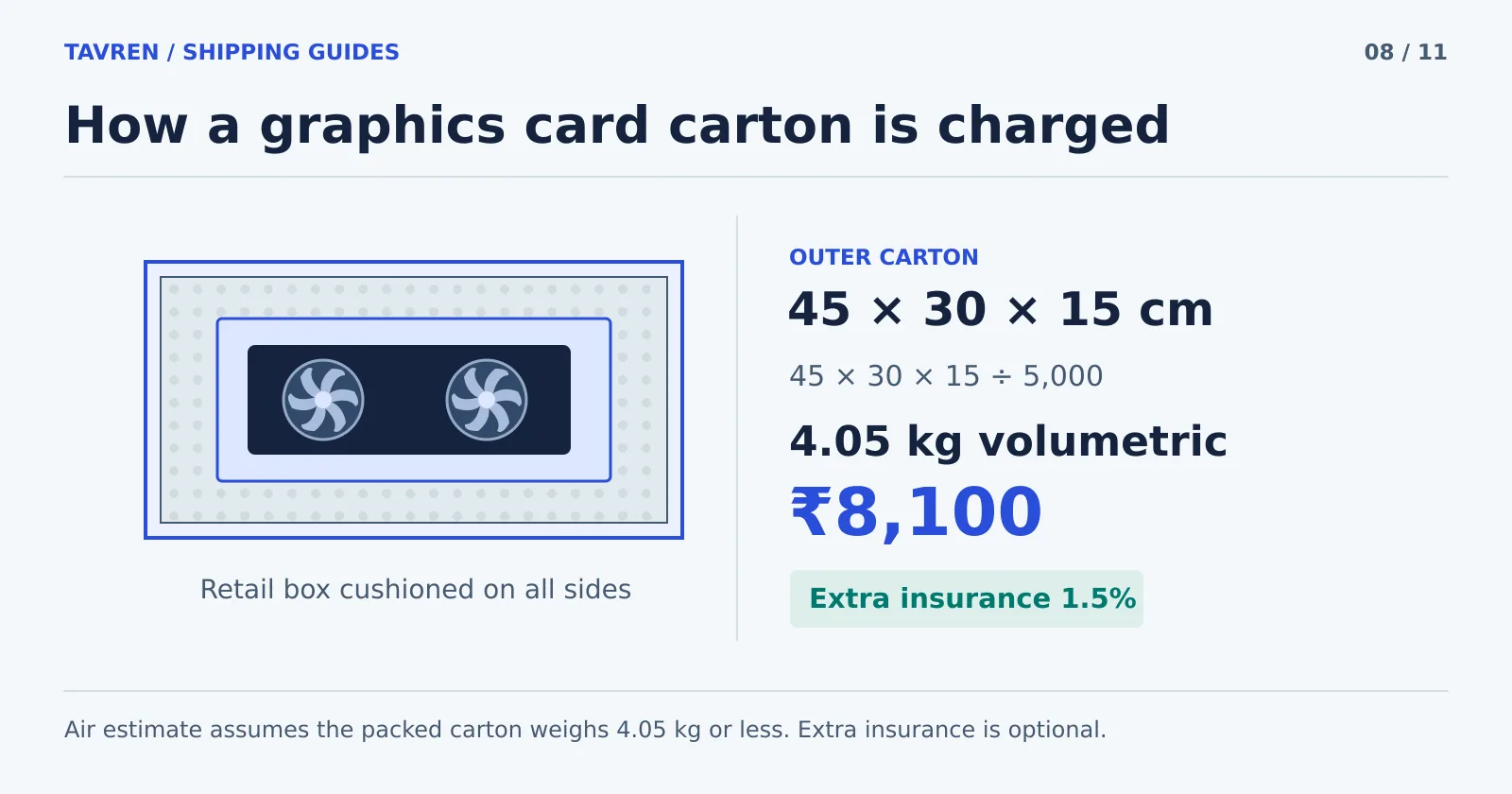
Air charges use the higher of actual and volumetric weight (length × breadth × height in cm ÷ 5,000). With the retail box inside an outer shipping carton, these are typical figures:
| Shipment | Actual weight | Volumetric weight | Air shipping |
|---|---|---|---|
| Mid-range card40 × 25 × 12 cm carton | 1.6 kg | 2.4 kg | ₹4,800 |
| High-end card45 × 30 × 15 cm carton | 3 kg | 4.05 kg | ₹8,100 |
| Card, CPU and memory together50 × 35 × 20 cm carton | 4 kg | 7 kg | ₹14,000 |
Duty and clearance are included in these figures. The final charge follows the weight and measurements at our Indian warehouse.
Packing and insurance
Ask the seller to ship the card in its retail box inside a sturdy outer carton with padding on every side, not in a mailer bag or the retail box alone. Standard forwarding doesn’t open or repack your parcel, so the seller’s packing is what protects the card.
Every shipment includes insurance up to ₹10,000 against loss. A graphics card is usually worth more, so add extra cover at 1.5% of its value: ₹900 on a ₹60,000 card. Cover is for loss, not damage in transit, which is another reason good packing matters.
Getting started
Send the listing link on WhatsApp. We approve the shipment, share the receiving address and, if you want us to buy it, confirm the price in rupees. Our PC parts shipping page has more examples, and the estimator works out your own carton.