
Air is usually the practical choice for a small shipment or a purchase you need sooner. Sea becomes attractive when you have enough goods to spread its minimum charge across several cartons. The useful comparison is the price for your packed shipment, rather than a price per kilogram beside a price per cubic metre.
At Tavren, air shipping is ₹2,000 per chargeable kg with a quoted delivery window of 12–14 days. Sea shipping is ₹27,600 per m³, with a 1 m³ minimum and a quoted window of 30–40 days. Both rates include international freight, customs clearance, duties and delivery in India for approved goods. Every shipment needs WhatsApp approval before you send it to a receiving warehouse.
What each rate measures
Air uses the higher of actual weight and volumetric weight for each carton. Actual weight is what the packed carton weighs on a scale. Volumetric weight converts its external dimensions into kilograms, using length × breadth × height in centimetres ÷ 5,000. Our volumetric weight guide explains this with examples.
Sea uses the total packed volume. Multiply each carton's external length, breadth and height in centimetres, divide by 1,000,000, then add the volumes. A shipment below 1 m³ is still billed at the 1 m³ minimum. For crates or pallets, share the complete packed dimensions when asking for approval.
Compare the same shipment in both modes
The examples below use identical cartons within each shipment. They show shipping charges only; the goods and delivery to the overseas warehouse are separate.
| Packed shipment | Air shipping | Sea shipping |
|---|---|---|
| 1 carton30 × 20 × 15 cm2 kg actual | 2 kg chargeable ₹4,000 | 0.009 m³ ₹27,600 minimum |
| 2 cartonsEach 40 × 30 × 25 cm10 kg actual each | 20 kg chargeable ₹40,000 | 0.060 m³ ₹27,600 minimum |
| 20 cartonsEach 40 × 30 × 25 cm15 kg actual each | 300 kg chargeable ₹6,00,000 | 0.600 m³ ₹27,600 minimum |
The first shipment is small enough for air to cost less than the sea minimum. In the second, air is quicker but sea saves ₹12,400. In the third, sea costs substantially less, provided its delivery window suits your plans. The table uses illustrative shipments.
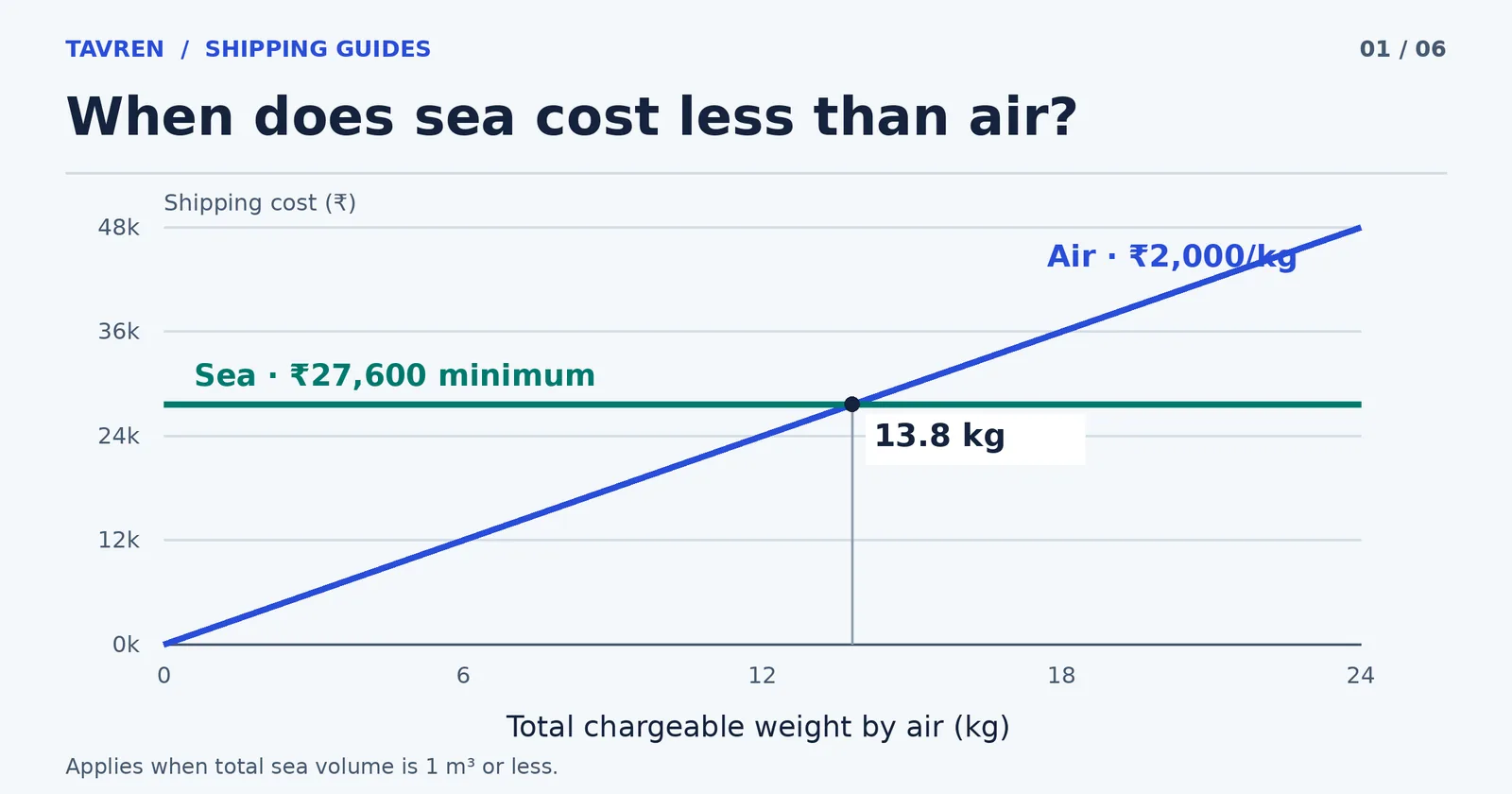
Where the minimum charge changes the decision
For a shipment whose total volume is no more than 1 m³, divide ₹27,600 by ₹2,000. The result is 13.8 chargeable kg. Below that weight, air costs less than the sea minimum; above it, sea costs less under these rates. At exactly 13.8 kg, the two shipping charges are equal.
This comparison uses chargeable weight, not just the scale reading. A light carton with large dimensions can cross that threshold. For shipments above 1 m³, calculate the actual sea charge instead of comparing against the minimum.
Allow time for the seller as well as shipping
The seller still needs to prepare the order and deliver it to the overseas warehouse. Ask about stock, production time and domestic delivery before choosing a mode. Confirm the shipment schedule with us during approval, particularly if the goods are needed for an event, installation or sales launch. The quoted windows are estimates, not guaranteed arrival dates for a deadline.
What to send for a useful estimate
Send the origin country, product link or description, number of cartons, each carton's external dimensions and packed weight. Mention batteries, liquids, fragile goods or other handling requirements. If your cartons differ, calculate them separately rather than multiplying one carton by the total count.
Use our shipping estimator for matching cartons, or send the full carton list through the enquiry form. We confirm the shipping charge after the goods reach our Indian warehouse and are weighed and measured. Payment is collected then, before onward delivery.
See what DDP shipping includes for a breakdown of the costs covered by each rate.